Online EXP Viewer
Open and preview Melco / Bernina EXP files right in your browser. See realistic stitches, design size, stitch count and estimated machine runtime — free, with nothing to install.
Your file is read locally in your browser to render the preview.
How it works
View an EXP file in 3 steps
Upload your EXP file
Drag a .exp file into the viewer or click Upload — it opens instantly in your browser.
Preview & customize
Switch fabrics, recolor threads, toggle jumps and play the stitch animation.
Read the details
Check stitch count, colors, size and estimated machine runtime before you sew.
Features
Everything you need to preview embroidery files
True-to-thread preview
Render EXP stitches with realistic thread shading on studio, t-shirt, cap, denim, towel and felt backgrounds.
Stitch-by-stitch Simulation
Animate the design the way the machine sews it, and estimate runtime from your machine's stitches-per-minute.
Recolor every block
EXP files store no thread colors, so the viewer assigns a palette — tap any color block to match your real threads.
Design details
Read stitch count, color-change count and exact design size in millimeters straight from the EXP stitch data.
Jumps, trims & stitch points
Toggle jump stitches, stitch points and the stitch line to inspect pathing and the trims EXP records explicitly.
Private & in-browser
Files you drop are parsed locally in your browser — nothing is uploaded to view a design.
Mobile friendly
Open, preview, measure and export EXP designs on any phone or tablet — the viewer is fully touch-friendly and responsive.
Export to PNG & PDF
Convert your design to a high-quality PNG image, or export a branded PDF spec sheet with stitch count, colors, size and thread length.
Verify on real fabrics
Check the stitch-out against studio, t-shirt, cap, denim, towel and felt backgrounds to confirm how it reads on different garments.
What is an EXP file?
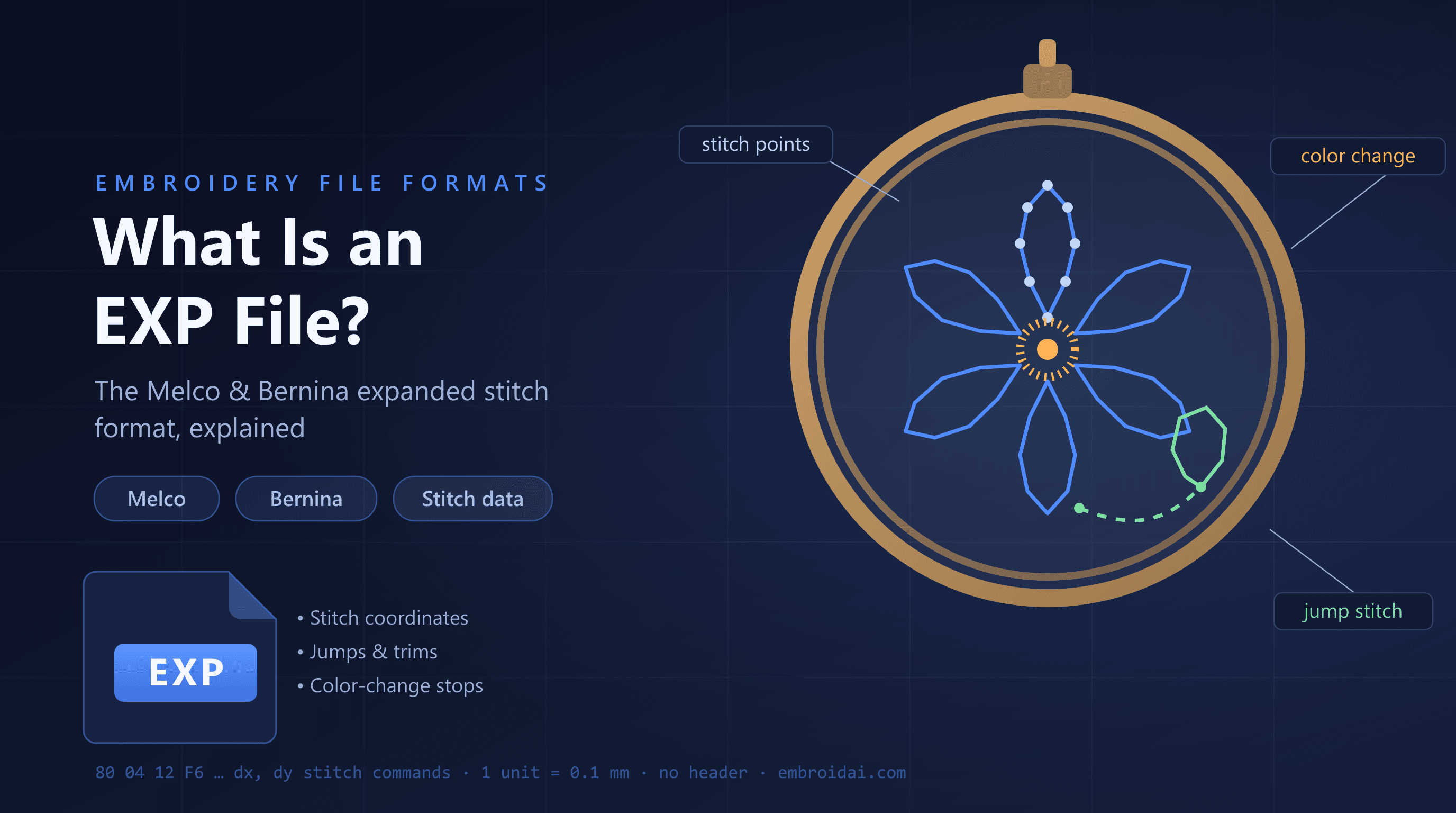
An EXP fileis the Melco Expanded embroidery format — the native production format for Melco commercial machines and the format Bernina home machines read from USB. It stores the exact stitch movements, jump stitches, trims and color-change stops that guide the machine through the entire design, one 0.1 mm step at a time.
"Expanded" means every stitch has already been calculated: unlike an editable design file, an EXP is the final machine-ready output of embroidery digitizing. That makes it extremely reliable in production, but it also means the file carries no thread colors, no design name and no editable objects — for Bernina machines, the colorway travels in a companion .INF file instead.
Because a raw EXP is binary stitch data, you cannot simply open it as an image. That is exactly what a viewer is for: our online EXP viewer reads the file directly in your browser and reconstructs the design with a realistic, true-to-thread preview. You can inspect the stitch path, recolor any block, switch the simulated fabric, and read the design size and stitch count before sending it to your machine — no desktop digitizing software required.
Want the full story on the format? Read our complete guide: What Is an EXP File?
Benefits
Why use our online EXP viewer
Fast, free and private — built to help you check a Melco or Bernina design before you commit thread to fabric.
Instant, in your browser
Your EXP opens the moment you drop it in — there is no upload queue, no processing wait and no software to install before you can see the design.
Free with no login
View, measure and export as many EXP files as you like without an account, a subscription or a watermark stamped across the preview.
Assign your real threads
Because an EXP file stores no colors, the viewer opens it in a clear default palette — recolor any block to preview the exact threads you plan to sew with.
Know the size and stitch count
Read the exact design size in millimeters, total stitch count and color-change count straight from the EXP stitch data to confirm it fits your hoop and garment.
Works on any device
The viewer runs entirely in the browser on desktop, tablet and phone — no plugins, no app store and no operating-system restrictions.
Estimate machine runtime
Enter your machine's stitches-per-minute and the viewer estimates how long the design will take to sew, so you can plan production and quote jobs accurately.
Supported machines
EXP works across Melco, Bernina and beyond
Native to Melco and Bernina, opened by nearly every digitizing program, and convertible for any other machine.
Melco
EXP is the native production format for Melco commercial machines, including the EMT and Bravo series — files load straight from the network or USB.
Bernina
Bernina home machines read EXP designs from a USB stick, usually alongside a companion .INF color file and .BMP thumbnail.
Commercial multi-head
For Tajima, Barudan, SWF and Ricoma heads that prefer DST, preview your EXP here, then convert it so it runs on commercial machines.
Other machines & software
Most digitizing programs — Wilcom, Hatch, Embird, Ink/Stitch — open EXP, so designs you preview here import into nearly any embroidery setup.
Running a machine that expects DST or PES? Preview your design here, then use the DST ⇄ PES converter to export the format your machine needs.
Common problems
Troubleshooting & tips
Quick answers to the issues people hit most when opening and previewing EXP files.
The colors look wrong or random
This is expected. EXP stores color-change stops but no thread colors, so the viewer assigns a default palette. Recolor the blocks to match the digitizer's color sheet or your Bernina .INF file.
My file will not open in the viewer
Make sure it is a genuine embroidery .exp and not an unrelated export file — a few non-embroidery programs use the same extension. Re-export a clean EXP from your design software and try again.
The design looks smaller or larger than expected
The viewer reads the true size in millimeters from the stitch data. If it seems off, it was digitized at that size — check the measurements before hooping so it fits your garment.
The design stitches poorly after resizing
EXP is expanded stitch data, so scaling changes stitch spacing without regenerating stitches. Resize the original digitizing file instead, or have the design redigitized at the new size.
There are long jump lines across the design
Those are jump stitches between sections. Toggle jump stitches off to preview the finished look — EXP records explicit trim commands, so your machine will cut them where the digitizer intended.
EXP viewer questions
EXP is the Melco Expanded embroidery format, also read by Bernina machines. It stores the exact stitch movements, jump stitches, trims and color-change stops that tell an embroidery machine how to sew a design — but no thread colors or metadata.
Upload or drag your .exp file into the EmbroidAI online EXP viewer above. The design renders instantly in your browser with a true-to-thread stitch preview — no software to install.
Yes. Viewing and previewing EXP files is completely free and does not require an account. Sign in for additional tools like saving designs to your library and exporting other formats.
No. The viewer runs entirely in your web browser on desktop and mobile. Your file is parsed locally just to display it.
EXP files store color-change commands but not the actual thread colors — the colorway travels separately (for Bernina, in a companion .INF file). The viewer assigns a default palette, and you can recolor any block to match the intended threads.
Yes. You can export the current preview as a high-quality PNG image, or download a branded PDF spec sheet that includes the design render along with stitch count, colors, size and total thread length.
Yes. The viewer is fully responsive and touch-friendly, so you can open, preview, measure and export EXP files on a phone or tablet — no app to install.
Both are compact stitch-only production formats that store no thread colors. EXP was developed by Melco and is native to Melco and Bernina machines; DST was developed by Tajima and is the de facto industry exchange format. They convert cleanly between each other.
EXP is native to Melco commercial machines and Bernina home machines, and virtually every digitizing program can open it. For machines that expect DST, PES or JEF, convert the design first.
Those are Bernina companion files: the .INF carries the thread color information and the .BMP is a small preview thumbnail. The .EXP itself holds only the stitch data, which is what this viewer reads.
Only slightly. EXP contains final expanded stitches, so scaling changes stitch spacing without adding or removing stitches. For significant size changes, resize the original digitizing file or have the design redigitized.
Jump stitches are travel moves the needle makes between separate parts of a design without stitching. The viewer lets you toggle them on or off so you can inspect the pathing and trims, or preview the clean finished look without the jump lines.
Yes. Enter your machine's stitches-per-minute and the viewer estimates the machine runtime from the total stitch count, which is useful for planning production and quoting embroidery jobs.
No. When you drop a file into the viewer it is parsed locally in your browser purely to render the preview. The design is not sent to or stored on a server, so your files stay private.
Want to do more than view?
Sign in to save designs to your library, digitize artwork with AI and export to DST, PES, EXP and JEF.